It’s Human Nature
An easy guide on how to be above average: one last article condemning the Palo Alto Unified School District. An old fart’s thoughts on why an AI-generated graduation is not something we should take lessons from. And I give you a dare.
By Boris Nezlobin
It’s Human Nature
Okay. Time for a complaint. I graduated yesterday—not a high bar, but still pretty great—and got embarrassingly sunburned. Here is Principal Brent Kline’s graduation speech:
…Thank you for making Paly feel like Paly.
And I mean that in some very real ways.
Earlier this year, there was plenty of talk about Spirit Week. But
when it finally arrived, there was no doubt: the senior class won,
hands down. Not just because of the points, the floats, or your
participation in the rallies, but because of the connections,
creativity, and enthusiasm you brought to the entire campus. You
reminded us that school spirit is not something we can force. It
happens when students decide together that it matters.
…
This goes on for a while—too long, considering how much UV was finding my
skin an inviting place—but to be honest I have no issue with his overall
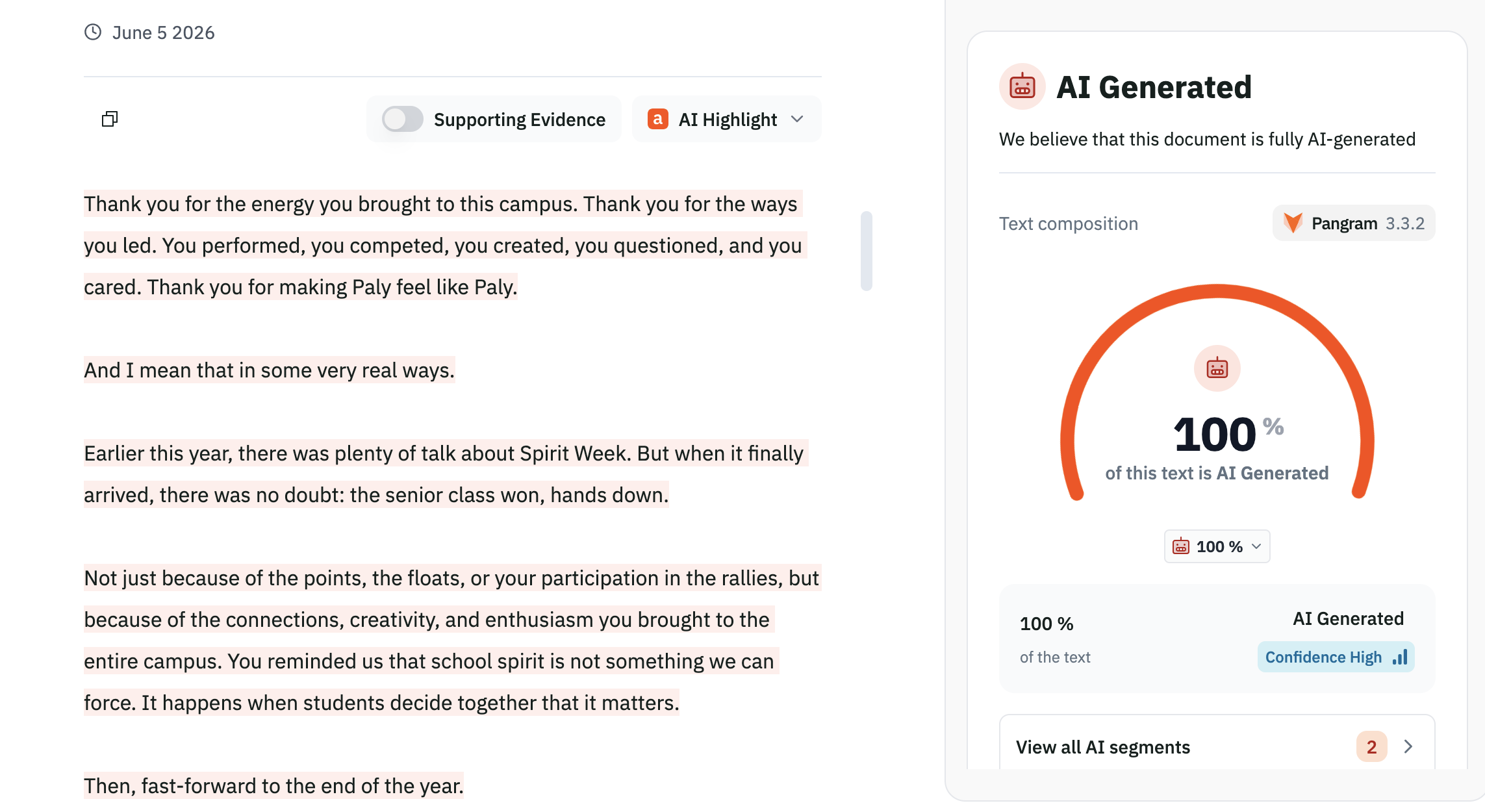
message. Neither does Pangram Labs, who agrees with me that this text is
100% AI-generated:
Pangram[1]
Results of Brent Kline’s 2026 graduation speech. Full report at
https://www.pangram.com/history/b7712f4f-89f0-4f72-be08-6a29a6337b2c.
And to be honest I’ve seen AI do some pretty cool things,[2] so I don’t particularly take issue with the fact that this speech is obviously entirely AI-generated, either. My particular issue is that this principal seems to not care too much about the very basic responsibilities that he is paid to put effort into. Did he even read the AI-generated script before giving the speech?
In this clip you can see he starts reading as though he expects there to be a list, which he would know isn’t there if he had written the script himself: https://www.youtube.com/watch?v=wGEuHurropo&t=2388s. In one of the few moments where he attempts to look up from the script, he really struggles to recall the words: https://www.youtube.com/watch?v=wGEuHurropo&t=2429s. In both cases, if he had written the speech, he wouldn’t have made those mistakes. He wouldn’t have spent 87% of the speech looking down at his script either![3]
And perhaps the worst part is that when you look closer, this speech barely even makes sense:
One example that has especially stayed with me this year was seeing Paly students featured on NBC Bay Area for work connected to economic mobility, peer mentorship, and the power of relationships. That story was not just about a class or a program—it was about something much bigger. It was about students recognizing that being in the same school is not the same thing as truly knowing one another.
That story wasn’t about a class or a program at all; it was about students appearing on the news. And what do either of those things have to do with students recognizing that being in the same school ≠ truly knowing one another, anyways? Of course students realized that… There is just no way a human wrote this and thought, “Yeah. Sounds right.” In fact, there is just no way a human wrote Brent Kline’s speech.
Why is my time being wasted by a guy who doesn’t even want to write a speech?
When you show no respect for what you do, you make it difficult for someone to show you respect for what you do. I promise this article isn’t just calling people out for using AI, but I’ve got one more thing to show before I move on. The student speaker’s speech!
But here's the thing no one really tells us: confidence doesn't come first.
A few weeks ago, I was still Googling things like "how to stay motivated" and "is three hours of sleep actually enough?" And now I'm here, supposedly qualified to give life advice.
If I've learned anything, it's that most of us didn't get here because we have everything figured out. We got here because we showed up—even when we were unsure, unprepared, or honestly, a little bit panicked.
And, of course:
here’s a link to the Pangram results. Now in case you still don’t trust AI detectors[4], here is me asking ChatGPT to generate me a speech:
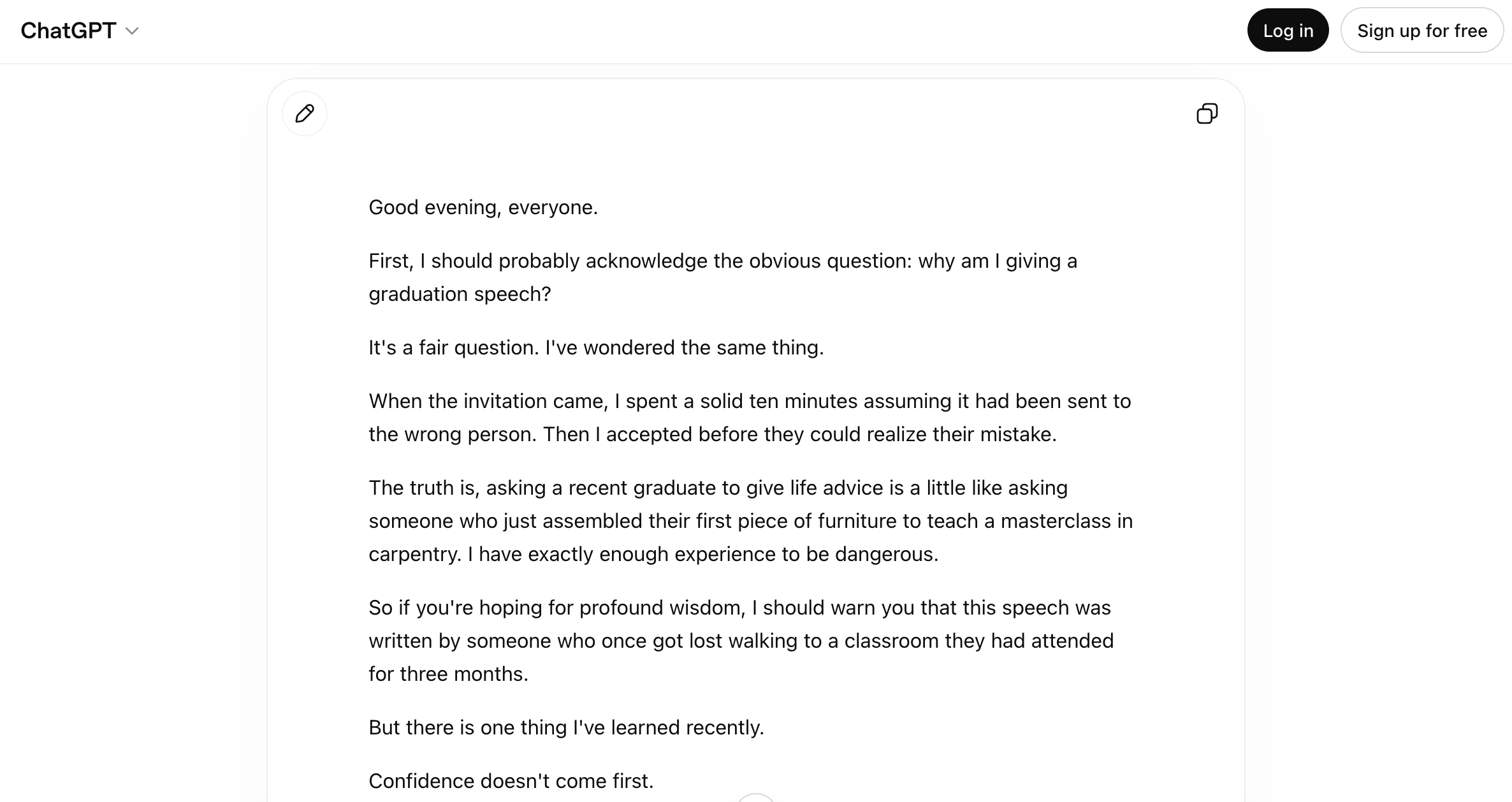
Notice that it opens the exact same way (“What qualifications do I have to be giving a graduation speech?”) and literally says the exact same words as its big thematic message? Yeah. “Confidence doesn’t come first.” That’s deep, dude. Come first in what? Actually, I don’t care, because it’s time to move on from calling people out—even I have limits, believe it or not. I didn’t audition to be a graduation speaker,[5] so I’ll use this as my chance to impart some advice to the graduating Class of 2026:
If you don’t want to write a speech, don’t give a speech.
Save yourself the time. Actually, save the time of the 2,000 people who expect a speech that is well-articulated, sensible, and authentic to your experience in high school.
There is a beautiful sort of message hidden in the old advice we’ve all heard: “Use your words,” we say to crying children. I always thought this placed emphasis on “words.” It’s better to talk it out than walk home with a black eye, right? It makes sense that my parents would give me that advice. But we live in strange times,[6] and for the first time I get this nagging feeling that maybe the emphasis should be about using your words—telling your story, using your opinions and judgement, about living your life.
What happens when you write with AI? When you can’t find it in your heart to write just 350 words (you’ve read just over a thousand so far) about your experience in high school? Do you really lack 350 words of original thought? These questions are not meant to be rhetorical: I encourage you to really think deeply about, and answer, all three.
I’ll give a part of the answer; the part of my answer I’d like you to keep in the back of your mind as you go out and take on the world’s biggest challenges. I struggle with concision, so bear with me for a second.
Here is an excerpt from the student speaker’s speech:
Because if the past few years have taught us anything, it’s this: we’re a lot better at being human than we are at being perfect.
And from Brent Kline’s speech:
You have also made mistakes. Because you're human. And because…
How likely is it that two writers—two people, two completely different perspectives (a student and an administrator; an insider and an outsider)—would arrive at this nearly identical phrasing? That both would contrast perfection with being human? Where is the originality of thought we expect of the people speaking in front of five hundred graduates and their parents? I know: I might’ve cherry-picked these sentences to prove my point. Of course. I do love trying to prove my argument.
Here’s a couple more, if you’re not convinced:
Kline: You do not need to have everything figured out tonight…
Student Speaker: …didn’t get here because we have everything figured out.
Kline: What matters is that you showed up. You cared. You tried. You supported one another.
Student Speaker: We got here because we showed up—even when we were unsure, unprepared, or honestly, a little bit panicked.
What is the probability that two independent writers would somehow settle on the exact same themes? Use the exact same phrases (“everything figured out” and “(student body) showed up”) in multiple occasions in the span of just three minutes of speaking?
I will tell you this: the answer lies somewhere in the fact that large language models are the statistical average of all language on the internet. One person’s ChatGPT session has the same stylometric signature—a unique tendency towards words, phrases, themes, and imagery—as someone else’s. This is why AI detectors are so good—even when told to write like Jar-Jar Binks, ChatGPT still reaches for the same language patterns and still gets detected. All large language models happen to be incredible at being exceptionally average when it comes to writing—and I can demonstrate this phenomenon to you quite easily, believe it or not. Even the sentence structures of the two speakers are the same. Ever heard of a rising tricolon?[7]
Kline: You know how to connect. You know how to celebrate one another. You know how to create memories that people will hold onto.
Student Speaker: You’re still scared. You're still unsure. You still hear that voice.
I’m glad you bore with me.
I can finally answer a part of those questions I asked you. This is what happens when you write with AI. The statistical average of the internet loves to talk about humanity. About imperfection, about the value of “showing up,” about chaos and honesty and things happening “quietly,” about confidence and the things “nobody tells you about when you…”—these are all great, but… missing something. Missing you. When you write with AI, suddenly you love to talk about imperfection and the value of showing up. You write this as though you have always loved writing about chaos and honesty.
And I can’t help but think of a line from Orwell’s well-known dystopia I have written on a post-it on my desk: “The past was alterable. The past never had been altered. Oceania was at war with Eastasia. Oceania had always been at war with Eastasia.”
Brent Kline had always loved talking about mistakes and being human…
This is what happens. The experiences you share, the arguments you make, the way you speak—they stop being your own. And many argue this is good (“Who gave this red-haired clown a blog? Is it too late to take it down? Can we get him replaced with AI please?”), but I promise it’s not. Bear with me, again! I’m well aware how this sounds: I’m just another old fart saying using AI is bad for you.
No.
This is not what I am saying. I’m quite a prolific user of AI, as I’ve burned just over sixty million tokens in Claude Code over the last month trying to build a startup; I’ve used Claude to prep me for AP Pyschology exams and to help me find the best camera lens; Claude has coached me through closing deals and talking to clients… So let me be clear: I am not an old fart[8] telling you not to use AI. There is no doubt in my mind that this is the most incredible technology of our time.
What I am saying, though, is to keep thinking. Keep being you. Why?
Because it’s human nature. Using AI (literally the statistical average of the human race) to write for you, to be creative for you, to make your arguments for you, compromises the value of you. When you can’t even write a terribly short speech to present at graduation, you admit defeat. You raise an intellectual white flag and admit that you are simply worse than average. You have no new idea, no new argument. You have no unique opinions or anything to contribute to a discussion. And how do you expect to be better—better than average; how can you hope to out-think the machines, if you don’t even begin to try? Who will pay you to work for them if you’ve made it clear they’re better off buying a ChatGPT Plus subscription?
I am human. I hope you are too—and if you are, live it.
So let me leave you with the questions I’ve asked you: What happens when you write with AI? When you can’t find it in your heart to write, or speak, or be original? Are you lazy, and do you really lack original thoughts? Are you driven to be better?
So here’s my take on graduation advice: I dare you to be human. Be proud of it, and be inimitable.
Be you.
I’m not sure what else to say. ChatGPT could doubtless add paragraphs upon paragraphs of content to this essay should I ask it to, but… I’ve said what I want to say. I decided on my message, decided how to present it, and now I’m done presenting it. I hope you have found this article well-articulated, sensible, and felt that it was authentic.
And if you don’t? Well: I am better for having tried. With that—Fin. I have just one thing left to append.
How can you expect to be original if you don’t even try?
P.S. I’m gonna be honest, I don’t have any post-it’s on my desk. I did write the quote down in my note titled “Cool Quotes” but that just doesn’t have the same material oomf-factor as saying I wrote it on a post-it. Do forgive me.
-
I understand that AI detectors have a bad rep. Pangram is a newer lab that has been independently confirmed to have a false-positive rate (FPR) of 1 in 10,000. Studies have found that it doesn’t fare too well in some domains (such as “recipes”), but performs extremely well in speeches. Both of these speeches screamed “AI-generated” at the time I heard them, but I’m including the Pangram reports (speeches generously transcribed by my girlfriend) as just one part of a broader case. Even if they are lying and their FPR is as bad as Turnitin or GPTZero (which both have an FPR of about 1 in 100), the chances of these speeches being human-written and both turning up as 100% AI-generated would be
-
Such as solving an open Erdös problem at the frontier of math research!↩︎
-
In all honesty I made that number up for dramatic effect.↩︎
- 2↩︎
-
I didn’t want to write a speech. There were too many requirements and it had to be about my time at Paly. A cursory look at my past writing—I See Dead People and my writing on MVC—should tell you that I’m not particularly in love with my time at Paly.↩︎
-
For the first time, automated (bot/AI agent) traffic makes up more than 50% of traffic on the Internet!↩︎
-
I can’t even be bothered to source this claim. I’m so done with AI-generated speeches and writing about them… I just want everyone to brand a “cogsucker” on the forehead of anyone who needlessly presents AI-generated content as their own work. Here is a Linkedin post about the rising tricolon, and other parts of AI-generated writing: https://www.linkedin.com/pulse/how-ai-uses-rhetorical-techniques-sound-melodramatic-why-dan-kaufman-9wgec/↩︎
-
I’m literally seventeen years old. Like. Trust me on this one, bro.↩︎