How many steps are on the Inca Trail?
I counted the stairs on the four-day and 34-km Classic Inca Trail to Machu Picchu.
Every guidebook and tour operator quotes a different number for the Inca Trail’s steps. The reason for that is simple: nobody has ever actually counted them. So I did.
I counted—by hand!—every single stair, step, and staircase on the four-day Inca Trail from Km 82 to Machu Picchu, tracking which steps were ambiguous and which were optional. Where the trail forked, I walked and counted both sides.
So here is the real answer: there are 9,862 stone steps on the four-day Inca Trail. You must climb at least 8,725 of those. This is not an estimate! Realistically, most hikers take somewhere between 9,679 and 9,854, depending on their route choices and side trips.
Where all the steps are
The Inca Trail isn’t one long staircase. It’s a 34-kilometre walk over a 4,207-metre pass and a long stone descent to Machu Picchu, with the steps bunched on the steepest pitches — gentle along the river, relentless on the drop through Phuyupatamarca. The chart below is the real trail: true elevation from a GPS track and topographic data, grey where you walk on dirt and red where the Incas laid stone. Drag to move along it, and zoom in until the red breaks into the individual steps.
Where the steps fall, day by day
The four days are nothing alike. The first is a gentle warm-up along the river; the second is the brutal climb to Dead Woman’s Pass — about 1,841 stairs up from the day-one camp to the 4,207-metre pass, the biggest single climb of the trek. The third is the longest, a knee-punishing 3,198-stair descent through the cloud forest; the fourth is a short pre-dawn push to the Sun Gate. Here is how the count splits across them.
- Climbed
- 278
- Descended
- 331
- Uncertain
- 25
- Climbed
- 1,841
- Descended
- 1,438
- Uncertain
- 74
- Climbed
- 1,484
- Descended
- 3,198
- Uncertain
- 369
- Climbed
- 550
- Descended
- 742
- Uncertain
- 72
How I counted them
There is no official count of the steps on the Inca Trail. Guidebooks promise “thousands”; none of them say how many. So over the four days from Km 82 to Machu Picchu I carried a notebook and tallied every staircase as I climbed or descended it — 1,389 separate flights of stone in all. As far as I can tell, this is the only place every step on the trail has been counted and put on a map.
Counting stairs turns out to be a question of judgement. Is a knee-high block with a flat top a step? A shallow ramp of cobbles? A single worn slab? I logged the clear ones, set the doubtful ones aside as “maybe” (about 540 of them), and marked the steps you can skirt around. Where the path forks, I counted both branches but charged only the shorter one to the climb you can’t avoid. That is why there are two numbers: the 9,862 steps that physically exist, and the 8,725 you actually have to take.
Neither extreme is what a real hiker climbs. Nobody skirts every avoidable step, and nobody treats every “maybe” as a stair. So the honest answer is a range: assuming you walk around a quarter of the avoidable steps and count half the doubtful ones, you take somewhere between 9,679 and 9,854 steps — the spread comes from which side of each fork you happen to walk.
To put all those steps on the real mountain, the profile is built from a firsthand GPS recording of the whole 34-kilometre route, sampled against 30-metre topographic data and pinned to the known heights of the pass, the ruins and the three camps — accurate to within a few metres. The steps are then laid onto the line by steepness, because that is where the Incas cut them: on the grades too steep to simply walk. Grey is dirt path; red is stone stairs.
The GPS also settled an old myth. The Classic Inca Trail is described almost everywhere as 43 km. It isn’t: a 6,000-point recording, the Peruvian Ministry of Culture’s own map, and the simple fact that Dead Woman’s Pass falls at the halfway mark all put it closer to 34 km.
The Inca Trail steps, answered
How many steps are on the Inca Trail?
There are 9,862 stone steps on the 4-day Classic Inca Trail, from Km 82 to Machu Picchu. That is not an estimate or a round number someone made up! It is a hand count, taken one step at a time over four days on the trail. You climb at least 8,725 of them on the most direct route, and the rest sit on optional detours and side-paths. Of the steps you actually take, 3,335 lead up and 5,390 lead down.
How many stairs do you actually have to climb?
At minimum, 8,725—that skips every avoidable step, ignores the ambiguous ones, and takes the shorter side wherever the trail forks. Realistically, this is near impossible to actually achieve, as in many cases it’s easier to take the step rather than avoid it. The full count of stairs that physically exist, both sides of every fork included, is about 9,862. The average hiker will climb somewhere in between, depending on how many side-paths they take (and if they take detours to various ruins or campsites).
Why is this count more accurate than other figures?
Because no guidebook actually counted. Tour operators and travel blogs throw out round numbers and no two of them agree because every one of those figures is a guess. I walked the entire trail with a notebook and tallied every stone step by hand, both sides of every fork, and marked which steps were optional and which were ambiguous. I put the count within about 2%—which is, give or take, infinitely more precise than a number nobody bothered to count.
What is the elevation profile of the Inca Trail?
Measured from a real GPS track sampled against 30-metre topographic data, the trail starts around 2,645 m at Km 82, drops to cross the Urubamba, then climbs to its high point of 4,207 m at Dead Woman’s Pass at almost exactly halfway. From there it undulates down past Runkurakay, Sayacmarca and Phuyupatamarca to Machu Picchu at about 2,492 m. You gain roughly 2,373 m and lose about 2,526 m overall.
What is the highest point of the Inca Trail?
Dead Woman’s Pass (Warmiwañusca), at about 4,207 m by 30-metre topographic data, is reached at the midpoint of the trek, at the top of the day-two climb.
How many stairs is the climb to Dead Woman’s Pass?
From the day-one camp up to Dead Woman’s Pass (Warmiwañusca) you climb 1,841 stone stairs, almost all of it unbroken uphill. It is the single biggest staircase of the four days: a relentless flight of Inca steps up to the 4,207 m pass, after which the trail tips over and begins its long descent toward Machu Picchu.
How many stairs are on the day-three descent of the Inca Trail?
Day three is the longest day and the hardest on the knees: an almost continuous stone descent of 3,198 stairs through the cloud forest past Sayacmarca and Phuyupatamarca. It holds more downhill stairs than any other day of the trek—more than half of all the descending steps on the whole route.
How long is the Inca Trail and how many days does it take?
By GPS the Classic Inca Trail measures about 34 km from Km 82 to Machu Picchu (it is often cited as 43 km, but a firsthand GPS recording and the Ministry of Culture’s own map both put it near 34 km). It is almost always walked over 4 days and 3 nights, though some marathon runners have completed it in under three and a half hours.
How were the steps counted?
By hand! I walked the Inca Trail with a notebook and wrote down every time I climbed a staircase. Doubtful steps (about 540 of them) are held aside as “maybe”, and steps you can step around, or that sit on a fork in the trail, are tracked separately, so the count can give both a true total and a realistic minimum. And yes: this means that when there were forks in the path, I went down both sides.
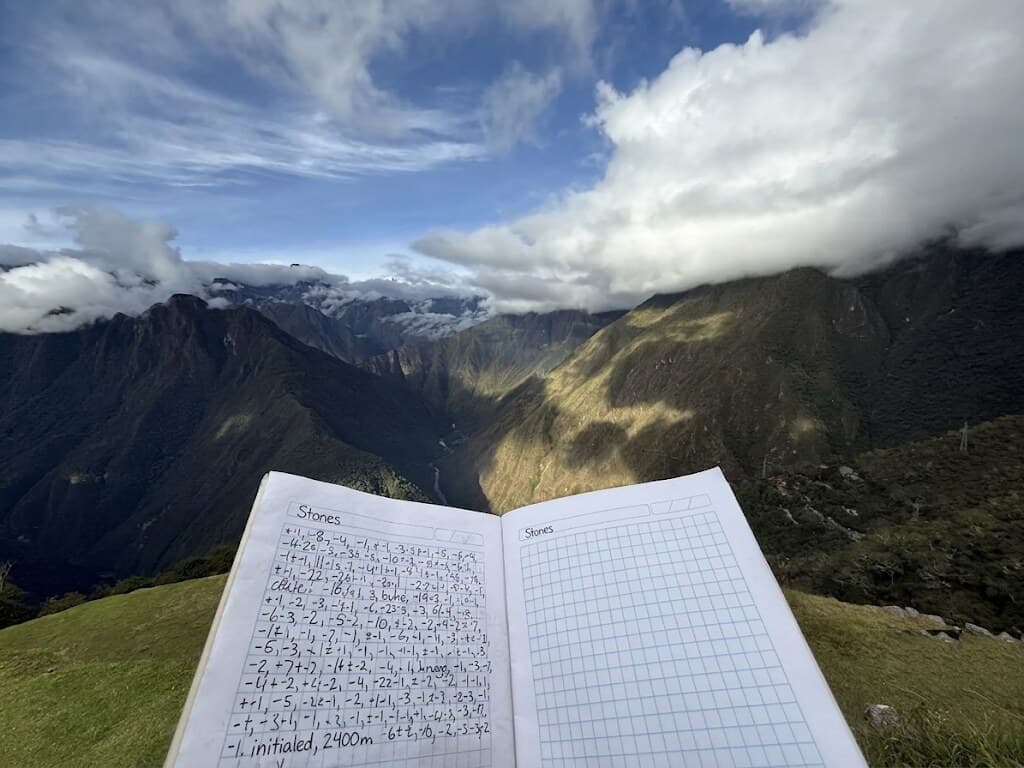
These are my own counts, and I stand behind them to about 2%. To be precise about what I counted: only the intentional, elevation-changing stone steps the Incas built.
That means on the third day’s steep cobbled ramps I left out a lot of what a casual hiker might call a “step.” All told, I’d reckon there are around 1.5x more stepping motions than built steps on the trail.
If you’d like the raw data, please reach out to me at www.borisnezlobin.com/contact.